#What We’re Seeing in Live Accounts
Across a range of industries, we’ve observed:
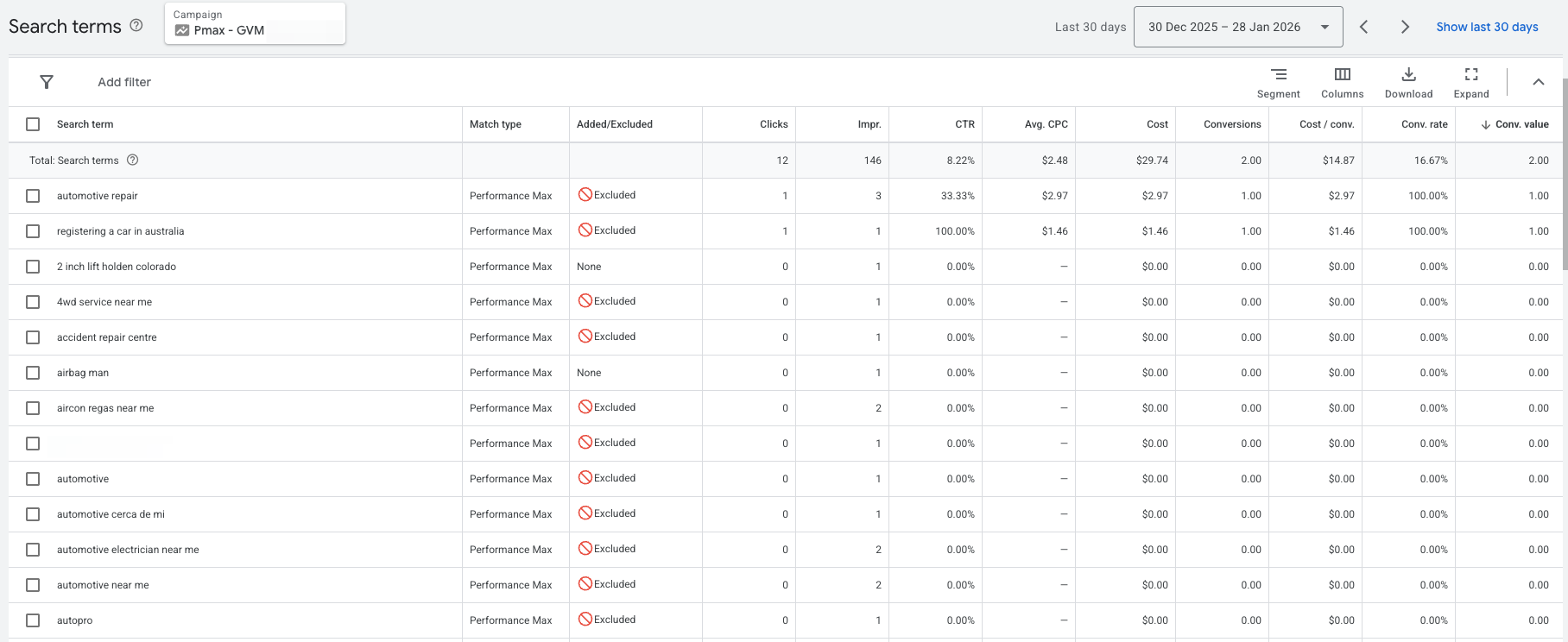
- Search terms that don’t match the client’s core offer
- Queries reappearing after being excluded
- Traffic that looks fine in-platform but fails downstream
Importantly, this isn’t about poor setup or lazy management. These accounts:
- Have clear conversion tracking
- Have documented negative keyword lists
- They are actively monitored and refined
Yet the behaviour persists.
The pattern is consistent enough that it’s no longer anecdotal. It’s systemic.
#Why This Is Happening
#1. Performance Max Optimises for Probability, Not Strategy
PMax doesn’t think in keywords. It thinks in terms of conversion likelihood.
If Google’s model believes a query is adjacent to a converting user, it may still serve, even when that query:
- Sits outside the intended positioning
- Produces low-quality leads
- Has been excluded for commercial reasons
In PMax, negatives guide the model. They don’t always stop it.
#2. Intent Drift Is an Expected Outcome of Automation
PMax is designed to:
- Expand coverage
- Find new demand
- Test edges of relevance
That’s useful when:
- Margins are strong
- Lead quality variance is acceptable
- Sales teams can absorb noise
It’s a problem when:
- Intent needs to be tightly controlled
- Certain searches are wrong, not just inefficient
- Clients feel the impact after the click
What we’re seeing is the system doing exactly what it was built to do.
#3. Google Is Forcing a Trade-Off
Quietly, but clearly, Google is pushing advertisers toward a choice:
- Automation and scale, with less visibility and control
- Manual structure and intent, with clearer guardrails
There is far less middle ground than there used to be.
#Why We’ve Moved Some Clients Back to Search
Standard Search campaigns still offer something PMax doesn’t:
- Hard negative keywords that actually stick
- Query-level transparency
- Clear intent segmentation
- Easier explanations to clients and sales teams
For businesses where:
- Lead quality matters more than volume
- Certain searches must never trigger
- Budgets need to be efficient, not exploratory
Search is still the better tool.
This is a strategic choice.
#When Performance Max Still Makes Sense
We still use PMax when:
- Conversion signals are clean and consistent
- Margins can tolerate exploration
- The offer has broad commercial relevance
- Search coverage is already strong
In these cases, PMax works best as:
A scaling layer on top of solid Search foundations
Not a replacement.
#Bottom Line
Performance Max is a powerful system. But it is not a precision instrument.
When intent control, exclusions, and lead quality matter, Search remains critical.
Our job is to use the right product.